




Micro-credential in Community-led Development Facilitation
Are you an experienced facilitator of community-led mahi? Do you support groups, whānau and communities to lead their own change but haven’t had a way to formally recognise those skills? Our Community-led Development (CLD) Facilitation Micro-credential is designed to validate and strengthen the real capability you already bring to your work.
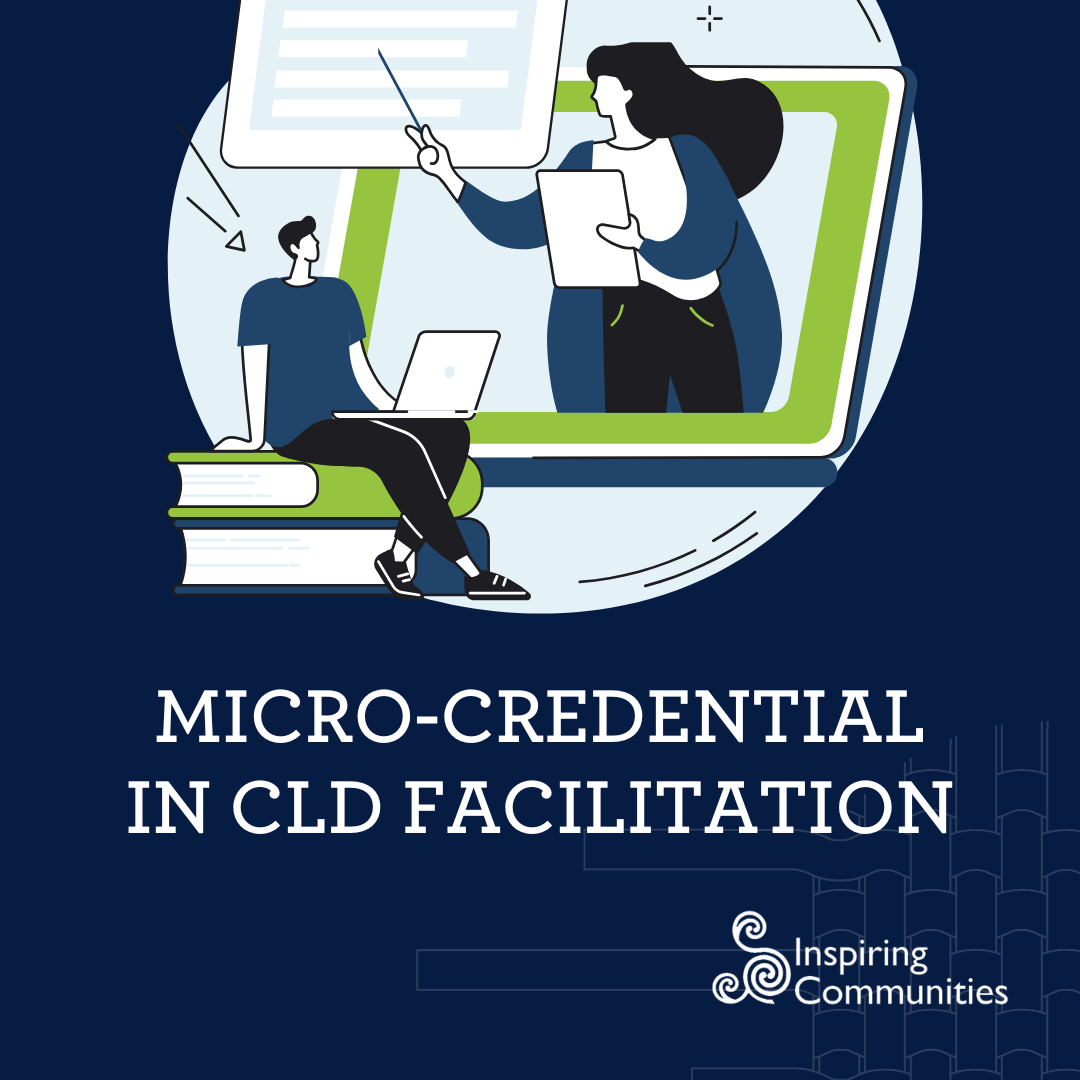
Inspiring Communities is thrilled to bring you this micro-credential. It will enable you to bring together, reflect on and share all you have learned about applying Community-Led Development (CLD) facilitation in your mahi.
What is it?
At the heart of this micro-credential is a written CLD case study drawn from your real-world facilitation experience. You’ll be guided through the process via four online workshops and two individual check-ins with an Inspiring Communities facilitator. These sessions help you plan, reflect, and shape your evidence. Your completed portfolio is assessed in Sept/Oct.
Upon completion you will have deepened your ability to support communities to lead their own change, strengthened your reflective practice, and built a clear portfolio that demonstrates your expertise.
With our 2026 cohort now underway, we’re inviting expressions of interest for 2027.
You can watch our recent Information Session here:
Validate your facilitation experience with a Micro-credential
This micro-credential requires critical reflection, using a case study from your current practice to identify and apply the competencies involved. This is more than just something to add to your resume. This is self-directed learning, but Inspiring Communities facilitators will support you through the process of developing your practice.
Micro-credential Key Dates 2026
Information Session:
- Wednesday 25th February, 1:00 – 2:00pm. Join us for this free online information session with one of our facilitators, who will share all you need to know about how the micro-credential works.
Online Workshop Sessions:
- Wednesday 1 April, 12 – 1.30pm: Exploring community-led development frameworks. Tools to identify and further develop your critical reflective practice
- Wednesday 3 June, 12 – 1.30pm: Unpacking the tasks of the micro-credential as they apply to your case study and your work
- Wednesday 1 July 12 – 1.30pm: Sharing progress to date, peer-to-peer feedback and identifying next steps
- Wednesday 26 August, 12 – 1.30pm: Getting to success. Critical reflection to support your completion of the qualification tasks
WHAT COSTS ARE INVOLVED?
The cost of our support package and assessment is $550 plus GST and booking fees for community organisations and volunteer groups and $750 plus GST and booking fees for local and central government, funders and private sector.
WHAT SUPPORT CAN I EXPECT?
- This is a self-directed learning process, with additional support along the way. The fee includes: two 1:1 guidance and planning sessions with one of our facilitators;
- four facilitated workshops, working together with others completing this qualification. There will be an opportunity each session to check in on how you are going, share successes, challenges, questions and find solutions. There will also be a structured topic introduced on each session as above;
- email support for one-off questions over the study period will be provided;
- assessment and moderation of your submission, with ability for one resubmit.
If cost is a barrier for you, consider including this activity within a grant application for professional development support – or email us at: kiaora@inspiringcommunities.org.nz about how we can help.
WHAT PRACTICAL CLD FACILITATION EXPERIENCE WILL I NEED TO TAKE PART?
The micro-credential is for people already working in communities, who have some knowledge and experience in community-led development approaches. You will draw on a situation where you are using your skills to help facilitate a community-led process, hui, meeting or workshop. You will demonstrate your experience of bringing people together, facilitating groups and coordinating local action, while critically reflecting on your process. The final submission requires you to provide evidence of your process and reflections.
HOW MUCH TIME WILL I NEED TO INVEST?
This is a self-paced qualification guided by facilitated workshops, culminating in your submission within the year of your enrolment. A wide range of resources and tools will support your learning. Past participants have found that around 2 hours a week over a 5 month period is a realistic time to set aside to manage the workload of the micro-credential. However study is an individual past time and you may work quite differently from this model.
WHAT DOES MY PORTFOLIO OF EVIDENCE NEED TO INCLUDE?
This is equivalent to a level 5 qualification.
Your final submission will include:
- background information about your CLD facilitation experience and current role(s)
- a case study for one CLD process you have facilitated
- attestations from one participant and one peer/mentor/supervisor/manager
- supporting documents that provide evidence of your facilitation process, outputs and/or outcomes (for example; agendas, minutes, action plans, community newsletters, reports)
- critical reflections of your practice within the context of your case study. These will include learning from the workshops, feedback, and readings
- a plan for your future CLD facilitation practice
FEEDBACK FROM 2024 GRADUATE, Ruth Nonu:
The micro-credential has been a valuable tool in my kete. It’s helped me to adapt and improve my facilitation skills, and to reflect deeply on our processes and practices. I’m grateful for the ongoing support from my team and the PWP members who continue to engage with aroha.
FEEDBACK FROM 2024 GRADUATE, Guillaume Willemse:
Through this work, I’ve learned the importance of stepping outside my comfort zone, collaborating with diverse groups, and embracing challenges as opportunities for growth. Mistakes are part of the process, and as long as I own them and learn from them, I will continue to improve.
FEEDBACK FROM 2022 GRADUATE, Leole Malama-Prasad:
I am grateful for the opportunity to complete the micro-credential in community-led development. I initially thought I would need to pull out due to changing roles and no longer working in communities, however I was able to still participate using my journey of passing over an external stakeholder relationship to someone else in my team. The structure of this course helped me to change the way I prepared for meetings, engaged with team members and ensured CLD stayed at the centre of our conversations. Being in a leadership role within a large government agency, the course also pushed me to think about CLD principles more in management and internal meetings that I wouldn’t have considered before. CLD can live and breathe in everyday mahi! I would never have thought this possible and highly recommend others who may not be directly community-facing to still participate in this course.
FEEDBACK FROM 2021 GRADUATE, Gemma Slack:
“Completing the micro-credential in community-led development was the best decision I have made as a facilitator for change. The experience gave me the language to communicate what had been felt working alongside the community for nearly a decade. It empowered me to become more effective in influencing others on the value of community-led development to transform communities from the inside out, not the outside in. The regular group calls were helpful to stay accountable and share wins worth celebrating and challenges faced to crowd-source perspectives and insights to stay motivated. I would highly recommend this course to anyone passionate about community change.”